
How to dimension conveyors
In connection with dimensioning of conveyors, in most cases, there are some general rules that can be followed, but variables such as the shape and weight of some materials may demand special dimensioning.
The following sections will provide information about dimensioning of the different parts of the SOCO SYSTEM conveyor system.
Frames
Frames are chief components of all modules. As standard, the frames are prepared for alternative axle pitches (spacing between the rollers).

The maximum load depends on the distance between the supports. As a rule, a distance between the supports of up to 2 metres will allow a load of max. 75 kg per metre to be carried on the conveyor.
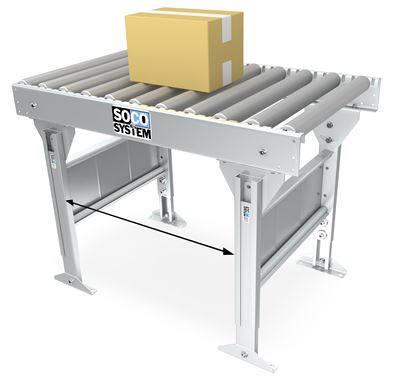
To ensure that the conveyor is stable, it is important that the distance between the supports do not exceed 2 metres.
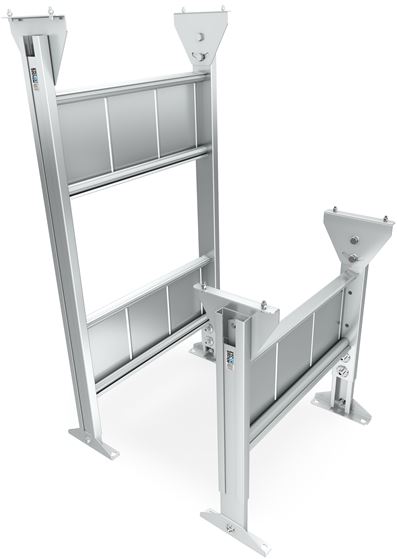
For conveyors above the height of 1.2 m and for driven conveyors and belt conveyors, supports with strengthening plates should be used.
Non-driven roller conveyors
To ensure smooth, unpowered product flow the gradient of the conveyor must be between 2.5 and 5 per cent. The exact gradient depends on the weight and the base of the products. This means that light items with rough bases require a steeper gradient than heavy, smooth-based items.
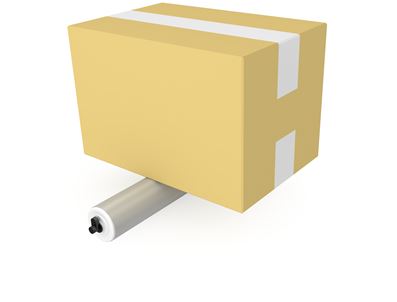
Each axle can carry a load of max. 10 kg. Therefore, if the items weigh 25 kg the product must constantly rest on at least three rollers according to the equation:
25/10 = 2.5.
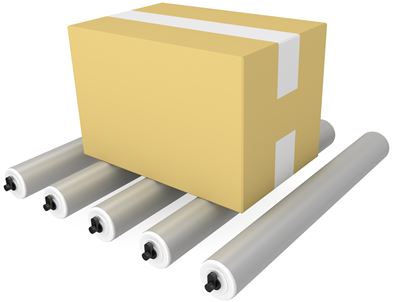
As a rule, the product must constantly rest on at least three axles. Flexible items such as net baskets, and similar products demand larger contact surfaces. Axle pitch is calculated by multiplying the length of the item by 0.3.
Example: 270 mm x 0.3 = 81 mm.
In this case, the axle pitch should be 60 mm to ensure that at least three axles are in contact with the item.
Non-driven wheel conveyors
To achieve smooth, unpowered flow, a gradient of between 2.5 and 5 per cent is required. Like with the roller conveyors, the weight and surface of the item are again important. Light products with rough bases require a steeper gradient than heavy, smooth-based products.
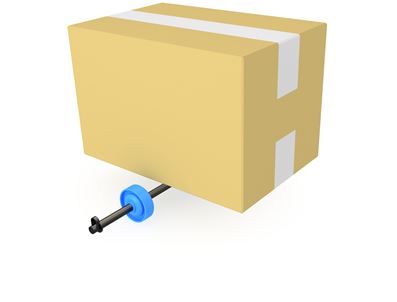
Each axle can carry a load of max.10 kg. Therefore, if the items weigh 25 kg at least three wheel axles must be in constant contact with the product according to the equation:
25/10 = 2.5.
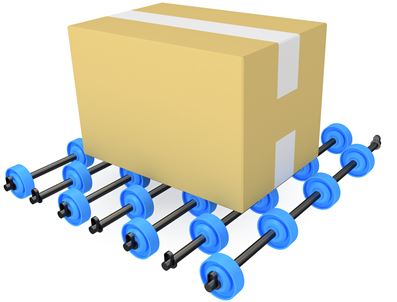
As a rule, there must be at least six wheels in contact with the product.
Driven roller conveyors
Generally, it is recommended that driven roller conveyors are used for horizontal transport only. On slopes, belt conveyors with higher friction between the product and the conveyor are recommended.
Each axle can carry a load of 10 kg for goods of full conveyor width. The number of axles supporting the product is calculated in the same way as for non-driven roller conveyors.
As a rule, there must be at least three axles in constant contact with the product all the time. Flexible-based loads such as net baskets, etc. require a larger contact surface.
Belt conveyors with plate bedding
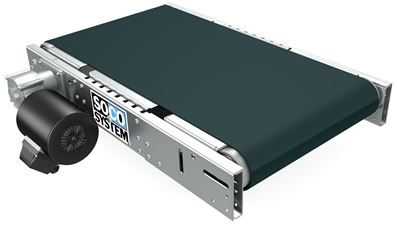
Belt conveyors with plate bedding offer increased stability compared with roller bedding. However, the tractive power is lower due to high friction between the belt and the bedding. Belts with guide profiles must always have grooved plate bedding.
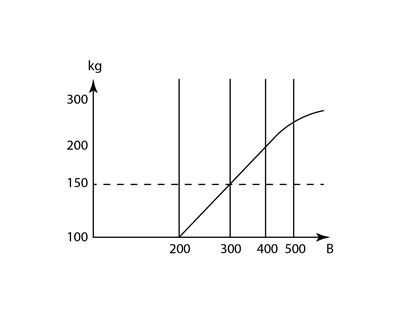
The total tractive power of a conveyor line depends on the belt width. The figure shows the tractive power in relation to conveyor width.
Example: A conveyor width of 300 mm gives a total tractive power of 150 kg.
Belt conveyors with roller bedding
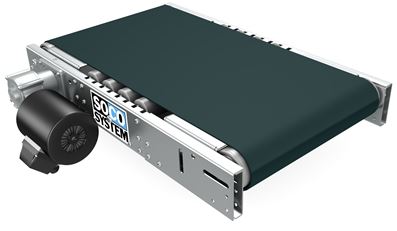
Belt conveyors with roller bedding run with minimum friction between the belt and the bedding. The total tractive power of a conveyor line depends on the width of the belt and whether the transport is horizontal or inclining.

Horizontal conveyor
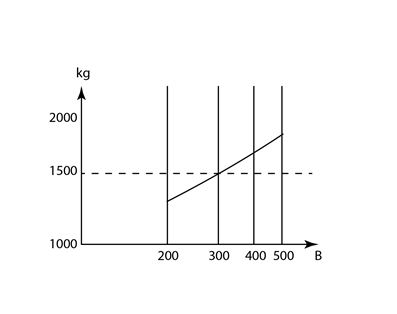
The figure shows the tractive power of a horizontal conveyor in relation to the width.
Example: A conveyor width of 300 mm gives a total tractive power of 1500 kg.
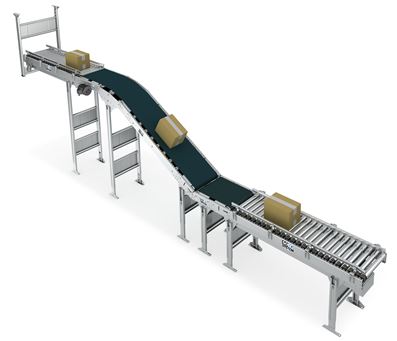
Incline conveyor
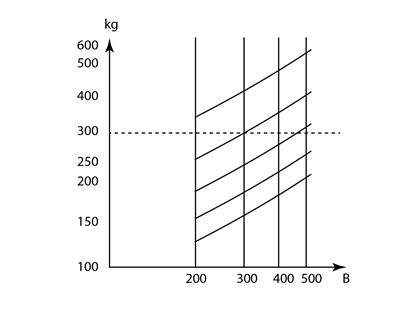
The figure shows the tractive power of an incline conveyor with width seen in relation to the degree of incline.
Example: A 300 mm wide belt conveyor with an incline of 15 degrees has a total tractive power of 300 kg.
Belt types
The type of belt needed for transport depends on both the type of transport and the surface of the items. For inclines and transport of smooth items, grip belts are recommended, whereas smooth belts are recommended for horizontal transport or for transport with slight inclines (10-12°) and for uneven based items.
Guide profiles ensure that the belt runs on track and are compulsory on belts with identical width and length or where the belt conveyor is loaded from the side. Belts with guide profiles must have beddings of grooved plate.
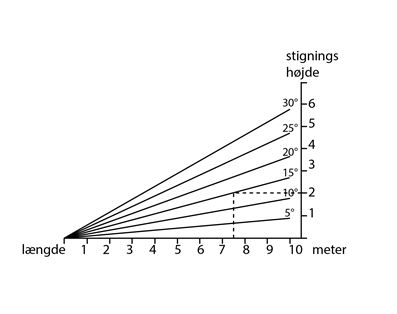
The diagram shows the angle of incline in relation to the conveyor length and height of incline. With a horizontal length of the conveyor of 7.5 m, and an incline of 2 m, the angle of incline will be approx. 15 degrees.